
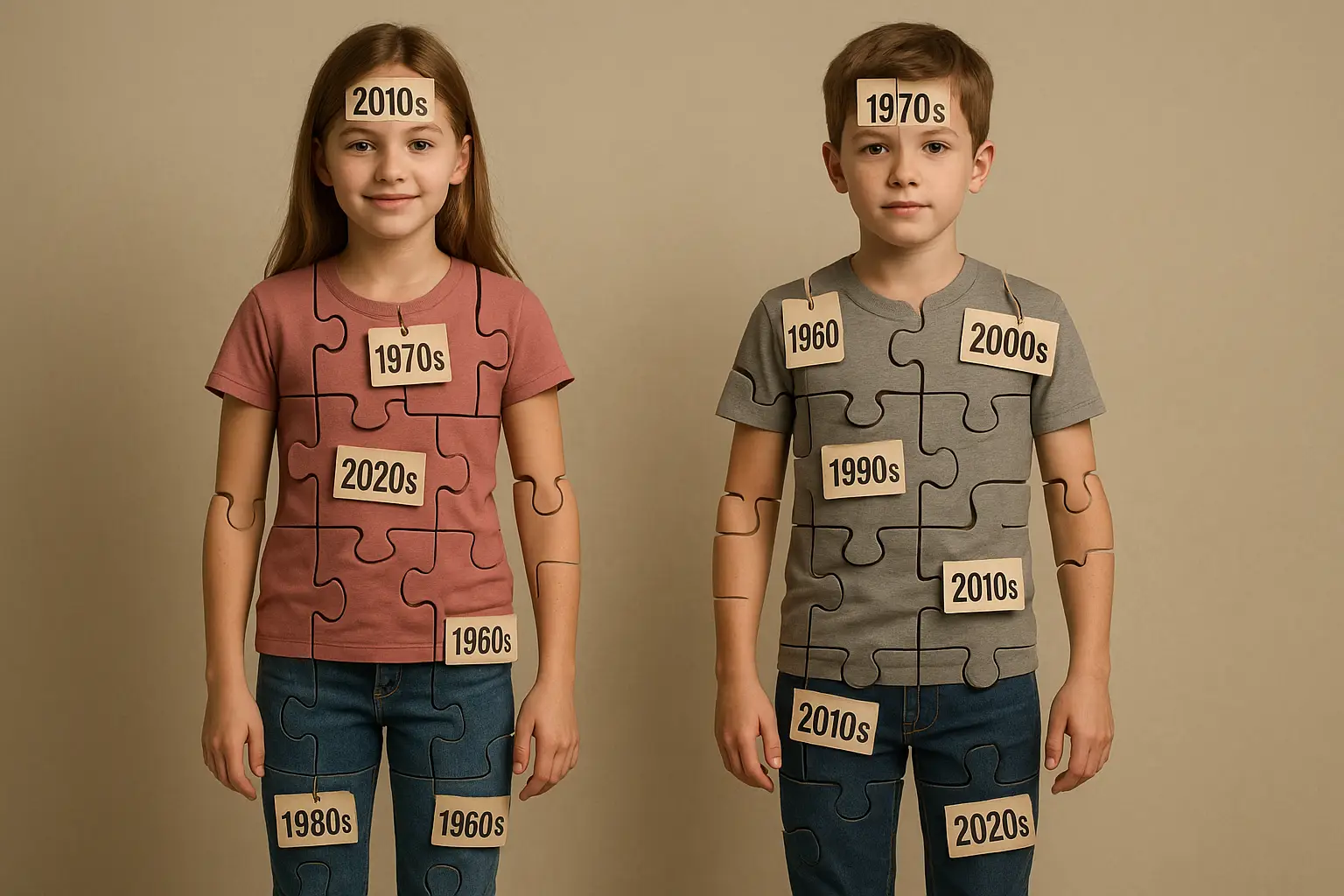
After raising kids in the ’70s and watching four grandkids grow up in four different versions of crazy, I’ve figured out that every decade got something right. So what if we built a kid using only the best parts? Buckle up.
The other day, I found myself watching my granddaughter scroll TikTok while doing homework, Facetiming a friend, and listening to music—all at the same time—and I thought, “Well damn. Kids really are built different now.” But are they bette
Then I started thinking—dangerous, I know—what if we took the best parts of being a kid from each decade I’ve lived through and mashed them together like some kind of parenting Frankenstein experiment? What would the perfect child look like?
The 1960s: The Age of Drink-from-the-Hose Freedo
I was a kid in the ’60s, when parenting mostly meant making sure your child wasn’t bleeding, on fire, or actively committing a felony. We had freedom. Real freedom. We rode bikes without helmets, skinned our knees daily, played kick-the-can in the street until the streetlights came on, and nobody had ever heard the words “playdate.” Honestly, the only thing monitored back then was our TV time—and only because someone else wanted to watch Bonanza.
Takeaway for today’s kid: Give them a bike, a wide open afternoon, and a little less supervision. And maybe a tetanus shot, just in case.
The 1970s: Boredom Was a Parenting Strategy
Fast-forward to the ’70s—when I was the one raising kids. That meant handing them a bowl of Spaghettios and saying, “Go outside.” There were no cell phones to track them, no baby monitors, and if you wanted a parenting book, you went to the library. We trusted our instincts—and by that I mean we mostly winged it.
Bored? Too bad. Boredom was character-building. That’s when kids invented things like stick swords and “let’s jump off the garage roof with an umbrella” (a decision we don’t recommend but sure made for a good story).
Takeaway: Let kids be bored. That’s where the weird ideas live. And honestly, they need a break from screens anyway.
The 1980s: Big Hair, Big Confidence
The ’80s? Pure swagger. We encouraged kids to dream big, blast Madonna, and believe they could do anything (even if they were tone-deaf with two left feet). After-school specials taught life lessons in 30 minutes, and Saturday morning cartoons came with a side of cereal and moral guidance. Confidence was king—even if it came with neon leg warmers and way too much Aqua Net.
Takeaway: Teach kids to own their weird. Confidence is a superpower, even when paired with crimped hair and jelly shoes.
The 1990s: Feelings Finally Showed Up
By the ’90s, parenting had evolved into more than just “don’t die today.” We started talking about feelings. There were entire campaigns about self-esteem, D.A.R.E. assemblies that scared the bejeezus out of kids, and a growing awareness that maybe yelling at your child in the middle of the grocery store wasn’t the best look. Kids learned how to name their emotions instead of punching their brother to express them.
Takeaway: Emotions matter. Let kids cry, talk, vent—and maybe teach them to apologize without saying, “I’m sorry you’re offended.”
The 2000s: The Rise of the Mini Tech Gurus
Suddenly kids knew how to configure a router before they could spell it. We handed them iPods, then iPads, and before we knew it, they were teaching us how to use technology. They had instant access to the world, could learn a language on an app, and Google the answer before you finished asking the question.
Takeaway: Keep kids tech-savvy—but for the love of humanity, also teach them how to write in cursive and use a landline. Just in case.
The 2010s: Be Yourself (No, Really)
This decade brought us a beautiful thing: acceptance. Kids didn’t have to fit one mold. They could be introverts, extroverts, gay, straight, non-binary, neurodivergent, or still figuring it out—and finally, there was space for all of it. Bullying became something schools actually took seriously, and diversity wasn’t just a buzzword; it was part of how kids grew up.
Takeaway: Let kids be unapologetically themselves. We spent generations trying to “toughen them up.” Maybe it’s time we just let them breathe.
The 2020s: Resilience and Digital Savvy
Ah, the 2020s—a decade that began with a global pandemic and has since been a whirlwind of rapid technological advancements, social changes, and new parenting paradigms. Kids today are growing up in a world where masks became a fashion statement, virtual classrooms replaced traditional ones, and digital devices are as common as crayons once were.
Best for kids because: They’ve developed resilience in the face of unprecedented challenges, adaptability to ever-changing circumstances, and an innate proficiency with technology that makes previous generations look like digital novices.
So… What Does the Perfect Kid Look Like?
If I got to build the perfect kid—using the best pieces from each decade—I’d end up with a beautiful mash-up that looks something like this:
- Has the independence of a ‘60s kid with a lunchbox and a curfew
- Knows how to entertain themselves like a ’70s kid stuck inside on a rainy day
- Struts into a room like an ‘80s kid who just got a new Walkman
- Can name their emotions and actually talk about them like a ’90s teen
- Fixes your printer and updates your phone like a 2000s tech whiz
- Accepts others and themselves like a 2010s empath with glittery confidence
- Adapts to change and navigates digital landscapes like a 2020s child who’s mastered Zoom and TikTok before age ten
Basically, they’d be unstoppable. We’ve all made mistakes raising kids—and I’ve made my fair share. But we’ve also gotten a whole lot right. Maybe we don’t need to raise perfect children. But taking the best of what we’ve learned along the way? Now that’s parenting wisdom.

